
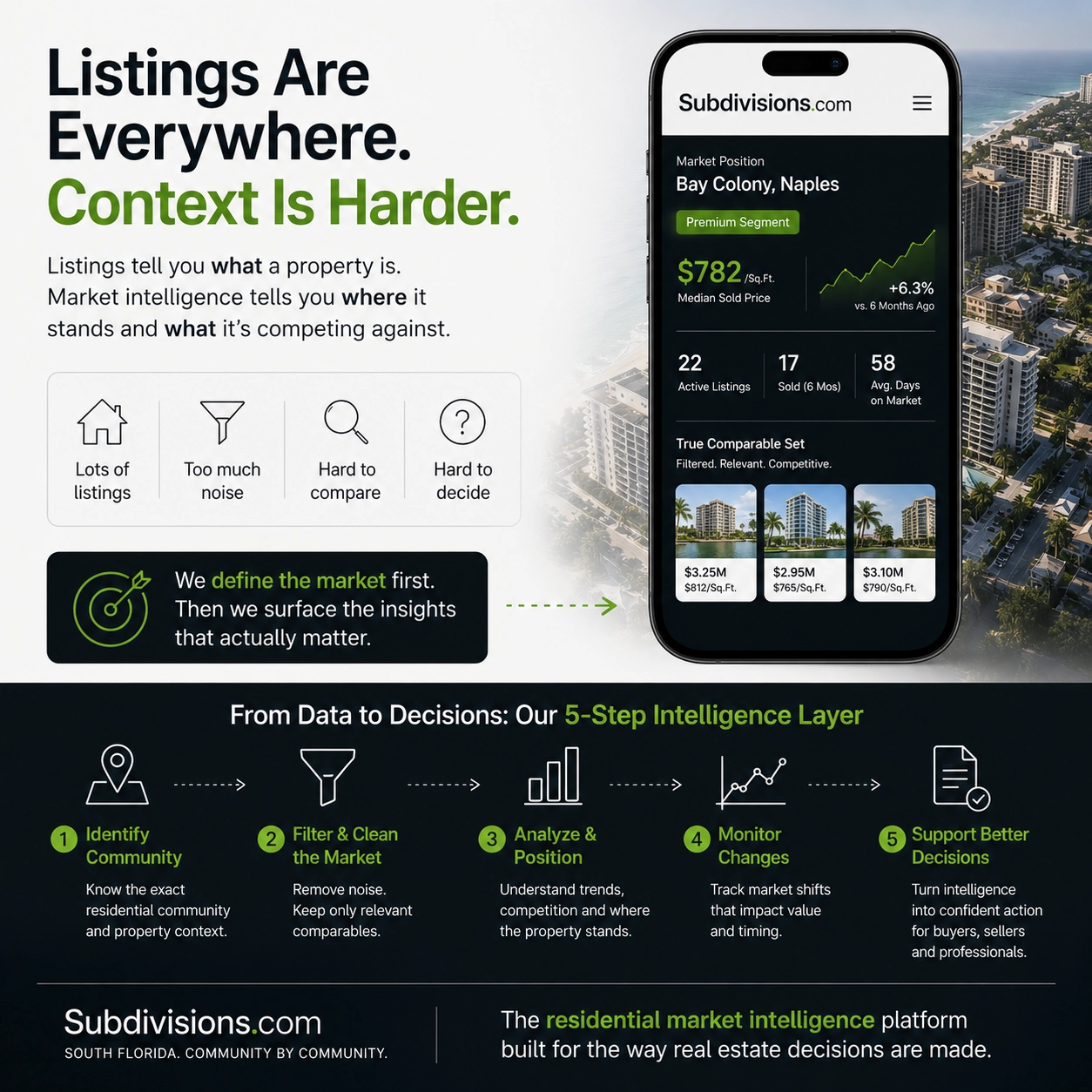

Real estate has never had more data.
Every major portal can show you what is for sale, what sold nearby, the asking price, square footage, bedrooms, bathrooms, photos, taxes and dozens of other property facts.
That solved an important problem: access.
But access to property data is not the same thing as understanding a property’s market.
And I think that distinction is becoming much more important.
A listing can tell you what a home is.
It cannot automatically tell you what that home should be compared with, what it is competing against today, or where it appears to sit within its actual residential market.
Those questions require another layer of work.
Before you analyze a property, you have to define its market
Imagine a condo listed in South Florida.
A conventional search can pull every recent sale within a mile. Add bedrooms, bathrooms and square footage, and you can narrow the list further.
That gives you candidates.
It does not necessarily give you the right competitive set.
The unit may sit in a building where floor, line, view, layout, ownership costs and current inventory materially affect which other units are relevant.
The closest sale geographically may not be the strongest comparison.
And the competition may not stop at the building.
A buyer could also be considering two or three nearby towers that occupy a similar price and lifestyle position.
The analysis therefore has to move in two directions at once.
Deeper, into the residential community, building and individual property.
Then wider, into the competing properties and peer communities that make up the real market around it.
That is where real estate stops looking like a simple search problem.
It starts looking like a data-structure problem.
This is the layer professionals already work in
Good real estate professionals already do this.
So do appraisers.
They collect records, review recent sales, reject weak comparisons, examine current competition, account for property differences and build a picture of the market around the subject property.
The important point is that much of that context still has to be reassembled for each analysis.
Search.
Filter.
Review.
Discard.
Compare.
Interpret.
Repeat.
The professional knowledge exists.
What has been much harder to build is a persistent data layer underneath that workflow.
One that already understands:
Which residential community the property belongs to.
Which building and unit context matters.
Which properties are strong comparisons.
Which are merely nearby.
What is competing today.
Which communities represent credible alternatives.
Where the property appears to sit inside that market.
That is a very different product from another list of listings.
Residential communities may be the missing organizing layer
Most real estate technology starts with familiar geography:
City → ZIP code → neighborhood → address
Those layers are extremely useful.
But residential real estate becomes more interesting below them.
Inside a city or ZIP code are the environments people actually buy into and live in:
Single-family subdivisions.
Gated and HOA communities.
Townhome developments.
Condo complexes.
Individual condo towers.
In dense markets, even different property segments inside the same building.
I think of this as the residential community layer.
It is not a replacement for geography.
It adds resolution to it.
A map becomes more useful when it can show not only where a property is, but how the residential communities around it are positioned, what alternatives surround it and where relevant competition exists.
The challenge is structuring that layer first.
More data does not automatically mean more intelligence
This is where I think real estate technology sometimes gets the equation backward.
The assumption is often:
More records → better analysis
But more records can also mean more noise.
Ten loosely related sales are not necessarily more informative than three highly relevant ones.
A larger radius does not automatically create a better comp set.
And adding another dataset does not help much if the system does not understand how its records relate to the property being analyzed.
The better sequence is:
Structure the market → filter the evidence → interpret the signals → support the decision.
That is the difference between data access and market intelligence.
At Subdivisions.com, this is the architecture we have been working toward: resolving residential markets from community identity through building and unit context, then using that structure for comparable selection, market position and decision-support products. The underlying data layer includes normalized community identities, property context, market signals and products built on top of the same infrastructure.
AI makes the problem more obvious
AI can process more property records in seconds than a person could review manually in days.
That is extraordinary.
But faster processing does not answer the most important upstream question:
Which records should the AI be reasoning over?
Give an AI model 500 nearby sales and it can summarize them beautifully.
But if 350 belong to the wrong competitive context, the system has produced a sophisticated answer from a noisy starting point.
AI makes raw processing cheaper.
That makes market definition, identity resolution and structured context more valuable, not less.
The model can interpret the evidence.
The infrastructure still has to determine what belongs together.
From listings to decisions
The next major evolution in residential real estate technology may therefore be less about showing people more properties.
We already do that extremely well.
The bigger opportunity is turning the enormous amount of property information we already have into better organized evidence around a specific decision.
For a homeowner:
What is competing with my property?
Which recent sales are actually relevant?
What has changed in my community?
Where does my property appear to stand today?
For a buyer:
How does this community compare with similar alternatives?
What am I paying a premium for?
What else competes in this price range?
For a professional:
Which evidence matters enough to bring into the conversation?
Those questions require more than a listing database.
They require context.
And context has to be structured before it can be analyzed.
Listings are everywhere.
The harder—and potentially much more valuable—problem is understanding how those listings relate.
That is where property data starts becoming market intelligence.
And where market intelligence starts becoming decision support.

Comments